
1. Technical Engineering & Polymer Selection for the Philippine Archipelago
Procuring functional eyewear retention hardware for distribution in the Philippines requires an engineering posture grounded in material science. The Philippine climate presents a compounding matrix of operational challenges: year-round ambient temperatures averaging 28°C to 34°C, an average relative humidity ranging from 75% to 92%, and intense equatorial UV radiation indices exceeding UV 11+ across Luzon, the Visayas, and Mindanao. Low-grade petroleum-derived elastomers and untreated nylon straps undergo accelerated hydrolytic degradation, photo-oxidative embrittlement, and plasticizer leaching within weeks of deployment.
As an established factory partner serving major optical retailers and occupational safety wholesalers in Metro Manila, Metro Cebu, and Davao City, our production architecture utilizes three certified polymer foundations specifically calibrated for tropical maritime longevity:
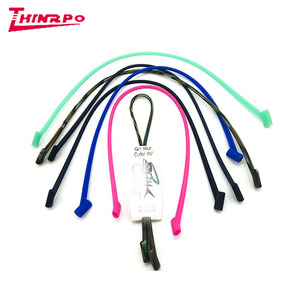
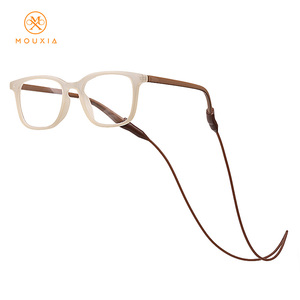
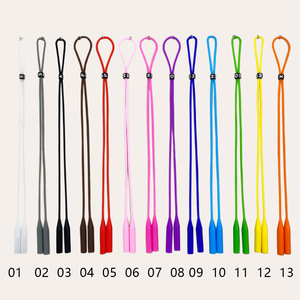
A. Medical-Grade Liquid Silicone Rubber (LSR): Formulated with a cross-linked polysiloxane backbone, our silicone retainer ropes exhibit near-zero hydrolytic decomposition. Unlike standard synthetic rubbers, our medical silicone retains its 55 Shore A durometer tensile elasticity without micro-cracking when subjected to skin lipids, sebaceous oils, and persistent saltwater saturation. The friction coefficient of our molded temple grips actually stabilizes under perspiration, ensuring zero slippage during active occupational movement.
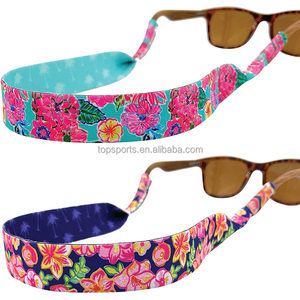
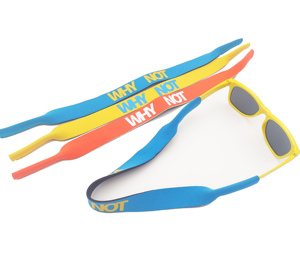
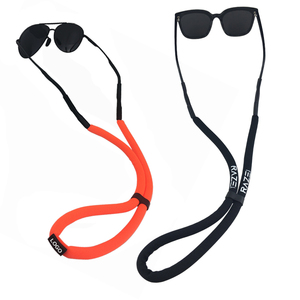
B. Closed-Cell Chloroprene Neoprene (CR Grade): Standard commercial neoprene lanyards often substitute cheap open-cell SBR (Styrene-Butadiene Rubber), which behaves like a sponge, trapping salty water, harboring mold, and developing sulfurous odors in humid storage warehouses in Pasig or Caloocan. Our CE certified floating sunglass retainers are synthesized exclusively with closed-cell chloroprene rubber laminated with anti-fray poly-spandex. This micro-cellular gas structure ensures inherent hydro-buoyancy (holding frames up to 45 grams indefinitely on ocean surfaces) while prohibiting water absorption.
C. High-Tenacity Braided Polyester with Internal Closed-Cell EVA Foam: Engineered for extreme tensile resistance (>180 Newtons before mechanical yield), our braided polyester cords resist abrasion from coral sands, volcanic soil, and industrial grit. Laminated with dye-sublimated graphics using azo-free eco-inks, they achieve Grade 4.5 colorfastness under accelerated Xenon-arc weathering tests.
2. Strategic Localized Application Scenarios Across the Philippines
The operational requirement for eyeglass and sunglass retention in the Philippines spans far beyond leisurely consumer fashion. Procurement directors must assess contextual demands across four primary vertical channels:
Marine & Coastal Tourism
For dive operations and coastal resorts in Siargao, El Nido, Coron, and Boracay. Floating neoprene straps prevent high-value polarized prescription glasses and luxury sunglasses from sinking in ocean waters.
PEZA Industrial & Electronics
Supplying manufacturing facilities across Laguna Technopark and Clark Freeport. Workers requiring prescription safety eyewear rely on non-conductive, anti-static silicone straps compliant with DOLE-OSHC standards.
Optical Retail Chains
Designed for clinic-level integration across dispensary networks like Executive Optical, Ideal Vision, and boutique practices. Custom branded retainers serve as high-margin dispensing counter add-ons.
Urban Commuting & Delivery
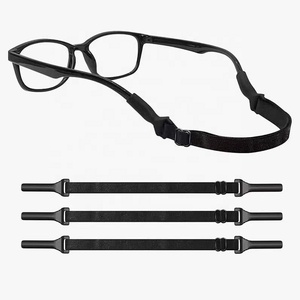
Over two million daily motorcycle riders and delivery fleets navigate congested Metro Manila transit. Sweat-resistant, elastic eyewear lanyards maintain critical vision stabilization under full-face helmets.
3. Procurement Trends in the Philippine Eyewear Accessory Ecosystem
As the Philippine healthcare, optical, and retail markets experience sustained post-pandemic consolidation, local procurement directors are evolving past generic bazaar-style trading items in favor of certified, systematically packaged inventory. We observe three distinct commercial patterns:
First, the shift from generic commodity sourcing to CE-marked occupational gear. Under Department of Labor and Employment (DOLE) Department Order No. 198-18 (the implementing rules of Republic Act No. 11058), safety standards across construction, maritime, and electronic assembly plants have tightened. Retainers utilized with personal protective equipment (PPE) must not present snagging hazards or skin irritation. CE EN 166 certification and skin-contact non-toxicity (REACH Annex XVII) documentation are now routinely requested by institutional tender boards.
Second, white-label private branding for high-growth local eyewear chains. Homegrown optometry chains and lifestyle apparel labels are seeking tailored visual identities. Rather than carrying anonymous factory inventory, distributors demand pad-printed logos, sublimation gradients, custom silicone mold debossing, and localized retail-ready barcode packaging that matches Point-of-Sale (POS) systems across shopping malls nationwide.
Third, supply chain de-risking and direct factory-to-port routing. Bypassing multi-tier middlemen in Binondo, corporate buyers in Quezon City, Makati, and Cebu City now establish direct accounts with accredited manufacturing plants. This transition secures verifiable batch traceability, 20-30% price advantages, and predictable ocean freight scheduling into Manila South Harbor or Cebu International Port.
4. Comparative Material & Structural Performance Matrix
The following engineering data outlines the mechanical and environmental resistance properties of our standard export retainers, providing objective metrics for corporate specification teams:
| Strap Core Architecture | Tensile Yield (N) | Buoyancy Capacity | Skin Biocompatibility | Salt-Fog Chamber Test | CE Certification |
|---|---|---|---|---|---|
| Molded Medical LSR Silicone | 120 N ± 5% | Non-floating (Negative) | ISO 10993 Cytotoxicity Safe | 120h without surface pitting | ✓ CE Compliant |
| Closed-Cell CR Neoprene | 145 N ± 5% | Positive (Up to 45g frame) | Hypoallergenic Spandex Facing | 96h zero laminate peel | ✓ CE Compliant |
| Braided Polyester + EVA Tube | 190 N ± 5% | Positive (Up to 35g frame) | OEKO-TEX Class II Weave | 72h hardware corrosion-free | ✓ CE Compliant |
| High-Elastic Polyurethane Knit | 110 N ± 5% | Non-floating (Neutral) | Standard Contact Safe | 72h elastic modulus retained | ✓ CE Compliant |
5. Enterprise Advantages: Built for High-Volume Optical Suppliers
Our operational capabilities reflect rigorous, factory-direct manufacturing standards built over years of international contract production. When sourcing wholesale optical accessories, our partners benefit from clear quality verification systems:
Physical Proof Approval Protocol
We do not rely on digital renders. A physical pre-production sample is cast or stitched, and high-resolution photographic validation (or physical courier dispatch) is approved before full industrial manufacturing starts.
Integrated Optical Focus
Unlike generic promotional merchandise brokers, our equipment, tooling, and quality gates are dedicated exclusively to eyewear accessories, guaranteeing micrometer-exact grip tolerances on frame temples.
Comprehensive Accessory Synergy
Consolidate your supply lines. Ship your custom retainers alongside wholesale hard-shell cases, anti-reflective safe lens cleaner sprays, microfibre cloths, and frame repair components in single container runs.