
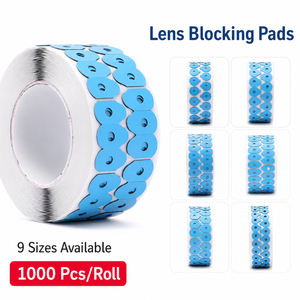
Our CE-certified lens edging pads are custom die-cut from proprietary high-tack acrylic polymers and micro-cellular foam substrates. Engineered to fit all leading edging platforms including Essilor, Nidek, MEI, Satisloh, and WECO.
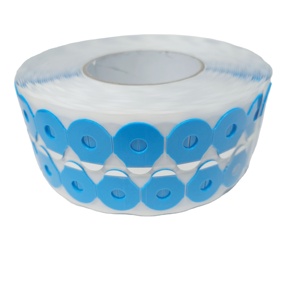
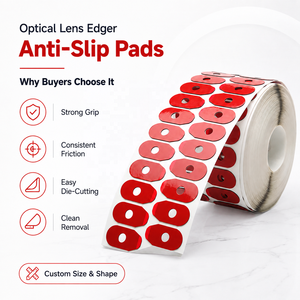
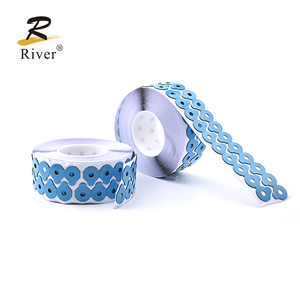
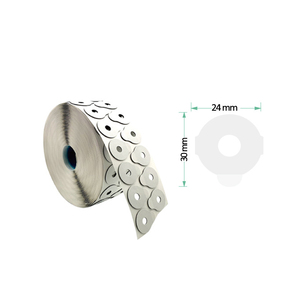
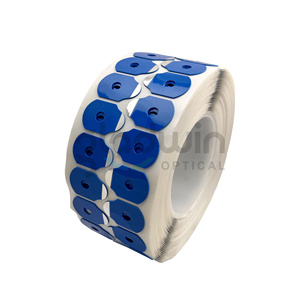
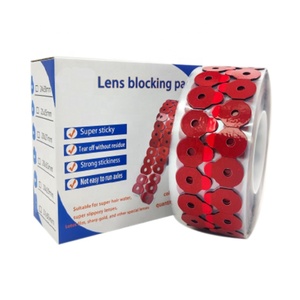
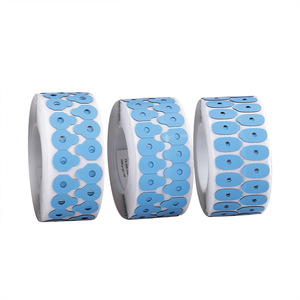
In modern prescription lens manufacturing, automated CNC wet and dry edgers operate at spindle speeds exceeding 8,000 RPM. Optical laboratories face significant scrap rates resulting from axis twist, optical distortion, and adhesive slippage on high-index substrates.
During diamond wheel contact, tangential torque forces exert intense shear loads on the lens-block interface. Our pads utilize a closed-cell cross-linked polyolefin foam core that absorbs radial shock and distributes cutting forces evenly, preventing axis deviation exceeding 0.05° even under aggressive roughing cycles.
The lens-side and block-side of an optical pad serve fundamentally different mechanical functions. We formulate a dual-chemistry system: the block-side adhesive is formulated for high-tack bonding to alloy or plastic blocks, while the lens-side utilizes a pressure-sensitive acrylic polymer engineered for zero molecular migration onto optical anti-reflective (AR) top-coatings.
Modern hydrophobic and oleophobic vacuum coatings present surface energies below 18 dynes/cm, creating a low-friction interface that causes standard adhesive pads to slip. Our proprietary HYDRO-Tack modifiers establish instant microscopic mechanical anchoring without requiring auxiliary anti-slip booster films or messy liquid primer sprays.
| Performance Parameter | Standard Commercial Pad | Industrial Lab Grade | Our CE-Certified Hydro Series |
|---|---|---|---|
| Torque Resistance (Nm) | 1.8 – 2.4 Nm | 2.8 – 3.2 Nm | > 4.5 Nm (Zero Slip) |
| Coating Compatibility | Uncoated / Basic Hardcoat | Standard AR (Broadband) | Superhydrophobic & Mirror |
| Carrier Substrate | Open-cell PU sponge | Standard EVA 0.8mm | High-density Crosslinked PE Core |
| Peel Cleanliness (ASTM D3330) | Occasional adhesive ghosting | Clean on standard glass/plastic | 100% Residue-Free on AR/Fluoropolymer |
| Edger Coolant Resistance | Degrades within 60s contact | Water resistant | Impermeable to emulsion & synthetic coolants |
As optical retail labs migrate toward compact in-store edging solutions and automated megasite centralized surfacing, procurement specifications for blocking pads are shifting rapidly.
Modern edgers, such as dry-milling CNC platforms, generate intense localized thermal friction compared to traditional slurry grinding wheels. Procurement teams are demanding adhesive formulations rated for thermal stability up to 110°C without adhesive plasticization or structural degradation that causes axis shifting during rapid blade passes.
Optical surfacing labs historically used expensive blue booster films over slippery AR lenses before attaching the blocking pad. The latest trend is consolidating to a single, high-adhesion hydro-blocking pad. This reduces cycle time by 4 to 8 seconds per job, eliminating consumable double-stocking and cutting consumable costs by up to 35%.
Industrial Rx facilities are automating lens de-blocking and blocking operations. Procurement specifications now mandate tight roll-tension tolerances, uniform pitch die-cutting (± 0.2 mm spacing), and silicone-coated PET release liners that prevent static electricity build-up during rapid automated peeling.
From raw adhesive polymerization to high-speed cleanroom die-cutting, our vertically integrated manufacturing facility ensures consistent thickness, zero pinholes, and uncompromised batch-to-batch repeatability.
All adhesive formulation, solvent curing, and substrate lamination occur within ISO Class 7 cleanrooms, ensuring zero dust, fiber, or particulate contamination on optical bonding surfaces.
Every batch undergoes automated optical inspection, dynamic torque shear validation, and compliance verification according to European CE marking directives and REACH chemical safety standards.
We engineer custom shapes for half-eye, rimless, high-wrap sports sunglasses, and specialized alignment notches tailored to specific block clamps (Essilor, Nidek, WECO, and custom OEM blocks).
Full OEM private labeling with printed release backing, customized dispenser roll sizes, and physical production proof verification before mass production runs.
Comprehensive engineering and procurement answers covering adhesive chemistry, torque thresholds, and high-volume wholesale parameters.
Request a comprehensive technical catalog, certified quality documentation, and free evaluation sample kits for your laboratory edgers.